Showing posts with label video games. Show all posts

Sunday, April 18, 2010

Stuff That I Think: Why Nathan Drake is the Greatest Villain of All-Time

Note: this post will contain spoilers for the first Uncharted game (but not the second, as I haven’t played it yet). If you care about the game being ruined for you, don’t read this post. Let it be known, however, that the game’s plot is not exactly Pulitzer-worthy, so you may as well read it anyways.


Haven't I seen this guy somewhere?

At first glance, Nathan Drake, the hero of the Uncharted: Drake’s Fortune seems like a pretty sweet dude. His ability to laugh in the face of danger, his dark-haired boyish good looks, and his knowledge of ancient cultures makes ladies swoon and men look up in awe. But what’s most enticing about Drake is the fact that beyond his adventurous experiences, he seems like a fairly regular guy; he reacts to things like grenades and swaths of enemies like most regular Joes would – “Shit”. Indeed, Drake seems like the kinda guy who goes to a bar in between international adventures, orders a couple beers and talks about sports while checking out ladies and making off-color remarks. He seems like the kinda guy that, despite being somewhat of a douche, you would probably get along with.

Except that you’d be dead wrong, because Drake is basically demon incarnate.

Drake takes a lot of his cues from another classic adventurer, Indiana Jones. Like Indy, Drake attempts to discover artifacts from ancient, dead cultures; what’s different is a question of character motivation. The way Indiana Jones works as a good guy is that his adventures are purely some fun on the side; he retains a day job as a university professor (though how he’s able to cut class whenever he wants to go on globetrotting adventures is a mystery to me). Most importantly, he seeks these ancient artifacts for the pursuit of knowledge – as he says, “artifacts belong in a museum”. Thus, while Indy obviously gets some self-satisfaction from the thrill and excitement of adventure, as well as an escape from his day job, his pursuit is a noble one.

You know why Nathan Drake risks his life to find artifacts from ancient cultures? Money. Oh, sure, by the end of the game, Drake is trying to find the treasure of El Dorado to save the world, but until the end of the game, everything Drake does is for cash. We get no indication that Drake has any sort of a day job – this cultural grave-robbing seems to be his primary source of income. This is not a noble pursuit; on the contrary, it is an entirely selfish one, actually depriving the human race of the knowledge that obtaining these priceless artifacts would bring. The only difference between Nathan Drake and Gabriel Roman (the villain of the game) is that Drake is young, pretty, and charming.

In fact, when you look at it, Drake is actually much worse than Roman. Looking at my medals from Uncharted, I can see that I killed, AT THE VERY LEAST, 380 people. This only includes the medals that I got for killing a certain number of enemies with a certain weapon – I didn’t get the medals for several of the guns. This means that chances are, the body count for the first Uncharted game is probably somewhere between 400 and 450. As far as I can tell, Roman doesn’t kill a single person throughout the entire game. Granted, you could make the argument that these people are all “evil”, but that doesn’t really work, as all of these people are there for the same reason that Drake is.

Not even Drake’s creators at Naughty Dog realize how much of a dastardly asshole he is. No remorse for his victims is ever shown, and it’s never hinted at that maybe, just maybe, Drake is wrong to be tracking down these things for his own personal means, or that he kills others with an attitude bordering on enthusiasm. The reason why Drake is the greatest villain of all-time is that he fools everyone, in-game and out: himself, his best friend, his love interest, his own creators, and, most importantly, the player.

Saturday, April 10, 2010

Stuff That I Played: God of War 3

Before I start the review, a quick note.  I realized the other day that I haven't actually written anything in regards to comics.  I'm sorry about this; all my new videogames have been cutting into my reading time somewhat.  I was writing a Dark Knight Strikes Again review, so hopefully that will see the light of day soon once I actually write the thing adequately.  I'm also almost done the short New X-Men Omnibus I just got, so expect something on that shortly.  Again, sorry about that.  I will rectify this ASAP!

Anyways, God of War 3.  Yay!  This review will be RELATIVELY SPOILER-FREE, but will likely have GOD OF WAR 2 SPOILERS.

For some reason, the actual box art didn't come up on image search, but this one's way cooler anyways.

I've been waiting for this game since the cliffhanger conclusion of God of War 2 in 2007.  Many people found issue with cliffhanger, but I understood - I wanted my epic Titan/God battles to be jaw-droppingly huge and furious, and this could not be done with the limitations of the Playstation 2.  Now on the next-gen Playstation 3, God of War 3 delivers almost everything I could have asked, albeit with a few issues.

The first thing I think I have to stress is the graphics, which are absolutely beautiful.  Everything looks fantastic - most impressive is Kratos himself, who's detail has been gloriously bumped up the last two games; he is now so good-looking that you can even see his pores.  This isn't to say that the rest of the game is slouches, of course.  The game runs extremely well; everything looks detailed and crisp, shading is outstanding, and the framerate runs at a steady clip.  In fact, the game runs so well that it took me about a half hour of playing to adjust to the speed of it: I'm just not used to seeing games look so good.  This also has the effect of making the game more brutal than the others, and that's really saying something.  Kratos gets realistically covered in blood as battles, people are decapitated with bare hands, and monsters are slit open, their intestines spilling out of their bodies.  It's all very gruesome, obviously.  Let's put it this way: the game looks so good that they didn't have to use any "cutscenes" to speak of - everything is done with the in-game engine (outside from a couple striking flashback sequences which are done in a stylistically different manner).  I assure you, you've never seen anything with this much scope and scale in a game before.


I wanted to do this side-by-side but couldn't figure out how.  Anyways, here's Kratos from a cutscene of the first game.....

.....And here's his in-game model from the third.  Hot damn!
                                                                                                           

God of War 3 picks up right from the end of the second game (SPOILERS): the Titans are storming towards Mt. Olympus to take revenge on Zeus for enslaving them years ago.  Kratos (our "hero"), having been denied of his revenge on Zeus in GoW2 and discovering that Zeus is his father, rides on the titan Gaia, and he is PISSED.  What follows is an appropriately brutal conclusion to Kratos's long journey of vengeance on the gods.  The plot is done pretty well, though after a few hours the game's narrative loses a bit of steam.  See, the problem is (SPOILERS) that by the halfway point of the game, you've already killed all of Zeus's brothers and two Titans, which means that for the last half of the game boss battles are relatively scarce and the plot becomes a tad unfocused.

Gameplay-wise, the game is largely similar to the first two games.  The combat remains relatively unchanged, though new moves have been added to deal with the larger number of enemies that are capable of being on-screen at once, such as the ability to use smaller enemies as battering rams.  The magic system has been replaced somewhat: now, each magic is tied to one of four different weapons, and what would be magic in earlier games are now side weapons, which have a refilling bar.  This is an interesting switch and one that works rather well - it means that you don't have to waste precious red orbs (which is what you upgrade your weapons with) on magic that you probably won't use that much, and allows you to use the more useful abilities (such as the bow and arrow) more often.  My one problem with this is that the game is too easy; it is without doubt the easiest of the three games, and this is largely due to the number of ways in which you can defend yourself.  Also, it's a bit of a bummer that out of the four weapons, three of them fall in the "chains with _____ attached".  While they all control pretty differently, I found myself not using the two chained weapons you get later in the game at all, sticking with Kratos's default weapon and sometimes switching to the Cestus (which are basically mythological boxing gloves).  This weapon balance is a problem the God of War games have always had, and it continues in the third installment.

One nice thing about the GoW3 is the puzzle design, which is actually really smart and generally pretty interesting.  The second game amped up the puzzles as well, but they were still largely based on boxes and switches.  The puzzles in this game are quite thoughtful, and all feel contextually appropriate (except for one weird rhythm-based puzzle which stuck out a little bit).  You won't get stuck on them, but you will have to take a look around the environment a bit and actually think of what you need to do.  It's a nice addition, and really helps break up the flow of the game in an effective manner.

The boss battles, as expected, are ridiculously over-the-top.  The best battles are the larger opponents, such as the breathtaking battle with Poseidon that begins the game.  The God of War series is known for having incredible opening sequences, and Poseidon is definitely the best opening of the three.  Bosses do not disappoint at all; there was one boss later on that I wasn't too sure about, but that's because the actual "battle" with him is extremely short - the difficult part is a really nice platforming section where you have to chase him down.  Now, this being said, I did feel like some of the kills were just a little bit disappointing; it didn't happen too often, but I found that some of the boss kills boiled down to "stab repeatedly in the same spot, decapitate".  It all adds to the brutality, but at times I was yearning for God of War 2's interesting, almost balletic kills.  Again though, this didn't happen enough to significantly affect my enjoyment the game.  Also, the problem with having such huge, impressive boss fights is that when you're NOT fighting a boss, the game feels small - it's a comparative thing and a problem that only comes with the mountainous highs of the thrilling bosses.

Pacing-wise, also like the other games, God of War 3 is incredibly strong.  The game keeps you moving briskly from one event to the next, switching between platforming, puzzles, fighting, and even some short flying sections (which are pretty improved from the boring flight sections of God of War 2).  The pacing does falter a little bit halfway through the game - the plot changes somewhat significantly, and boss battles are scarce.  This means the last half of the game is a little bit closer in feel to the first two games as opposed to the largeness of this one.  It also loses the exploratory feel of the second game; it's more like the first game, where you explore one or two really large areas, at times backtracking through older sections with new abilites.  It's a bit of an unfortunate sacrifice, and means you don't see too much variation in environments.  Luckily, the game picks itself back up in the last few hours as it approaches its conclusion.

Which leads to some controversy.  The ending of the game has been a little bit disputed with critics; some consider it a stroke of genius, others have been less than impressed.  I don't want to talk about it too much for fear of ruining it (that's for tomorrow's post), but I thought the conclusion was perfectly fine; however, I took issue with the actual END of it, as in the last minute and short epilogue.  More on this in a crazy spoiler post tomorrow.

As a side note, one you beat the game you unlock a bunch of behind-the-scenes videos.  God of War games have always had an hour-ish long mkaing of feature, and GoW3 has that AS WELL as individual features about specific parts of the game's design, i.e. voice acting, writing, animating, etc.  If you like this kind of stuff (and I do), it's a very cool bonus.

Play this game if:
-You played and enjoyed the other two (three if you count the PSP one) God of War games.
-You want some crazy ridiculous action sequences and boss fights
-You want to see the best graphics in current video gaming thus far.


Don't play this game if:
-You're squeamish
-You can't handle over-the-top, somewhat comic book-esque plots and dialogue
-You haven't played the other two main games in the series (and seriously, if you want to play this one and you haven't played the others yet, what's your excuse?  Go out and buy the HD remasters of them!  They look great!)
-You want a deep battle system - I say this because while the system is very intuitive and controls extremely well, it's not the deepest fighting system in a game of this type.  Put it beside the Ninja Gaiden or Devil May Cry games and there's really no contest.


Later days,
Daniel

Thursday, April 8, 2010

Stuff That I'll Be Reading/Playing/Listening To

Yo.  So, I thought I'd just make a quick list of music/books/comics/videogames that I plan to check out this Spring/Summer.  This list is more for me to sort out all the things I want to look at the summer, but you can also expect to see pieces on all of these (that I actually decide to check out), whether they be reviews or other things.  These are in no particular order.

Videogames
- Assassin's Creed 2
- Alan Wake
- Just Cause 2 (currently playing)
- God of War 3 (currently playing, should be done by tomorrow)
- Skies of Arcadia (currently playing)
- Uncharted: Drake's Fortune (currently playing)
- Uncharted 2
- Transformers: War for Cybertron
- Splinter Cell: Conviction
- Blur
- Super Street Fighter IV
- Iron Man 2 (we'll see once reviews come out, but it looks rad so far)
- Prince of Persia: The Forgotten Sands (same deal)
- Pokemon: HeartGold/SoulSilver (if I have time)
- Lego Harry Potter
- Crackdown 2
- Condemned 2
- Shenmue 2 (if I can find it)
- Silent Hill 2 (same)
- Bayonetta

Books
- Fear and Loathing in Las Vegas
-The Hitchhiker's Guide to the Galaxy series (I say I'm going to read this every year; we'll see what happens.  I read the first two a long time ago and loved them, but stopped with the third for some reason)
- Catch 22
- Cat's Cradle
- Breakfast of Champions (reading now, almost done)
- The new A.J. Jacobs book (once they release it in softcover)

Comics
- The entire Marvel Ultimate Universe (reading now, about 2/3 of the way through it)
- The Punisher Omnibus by Garth Ennis (got this for my b-day, haven't started reading yet)
- Punisher MAX by Garth Ennis
- Automatic Kafka
- Blackest Night
- Scott Pilgrim vol. 3-5
- Box Office Poison
- Joe Kelly's Spiderman
- Dark Reign/Siege
- The Losers
- The Boys
- The rest of Grant Morrison's New X-Men (I have the first Ultimate Collection)
- Astonishing X-Men
- Tag and Bink Are Dead
- reread Y: The Last Man
- reread Preacher
- There must be more.  I can't think of any right now, but I know there's more.

Music
- Gorillaz - S/T
- Blue and Exile - Below the Heavens
- Wilco - Summerteeth, S/T
- Talking Heads Discography
- Flaming Lips Discography
- I actually need more music.  GIVE ME MORE MUSIC TO LISTEN TO!!!  I will accept almost anything as long as I know it doesn't suck.

That's everything I can think of right now.  If I add anything I'll make a note of it in other posts.  Also, any suggestions in regards to books, comics, and music are encouraged!

-Daniel

Tuesday, April 6, 2010

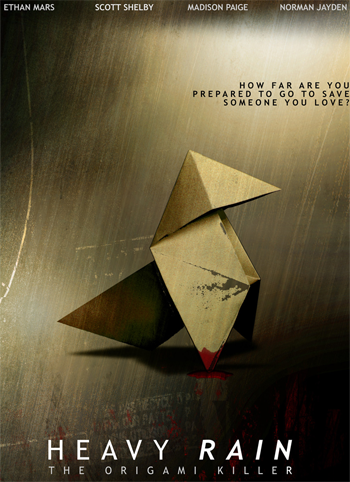
Stuff That I Played: Heavy Rain

SPOILER-FREE, so don't worry about reading.

A friend of mine recently was kind enough to lend me his PS3 because he has to study for exams, so I'm finally able to play through some of my most anticipated games on the console. This is gonna be pretty quick because frankly, it's hard to judge Heavy Rain in relation to other games because it's so unique.

Heavy Rain isn't really a "game" per se. It's more of an interactive movie; I suppose it's sort of like if you were able to say "DON"T GO THROUGH THAT DOOR!" during a horror movie and that character actually listened. The game is extremely immersive as you control the most basic of actions; the first hour or so of the game basically just has you go through one of the main characters' morning routine, getting dressed, brushing his teeth, eating, etc. Some would find this boring but due to the interesting control scheme and overall uniqueness of the game, it really worked for me.

Most of Heavy Rain is played using a variety of quicktime events. For those who don't know, what happens here is that you don't control the entire character; rather, a cinematic plays, and button prompts are put up on the screen. If you press the button in the the required, you "Win" the action; this keeps going in a particular sequence. For example, you control Guy A in a fight. Guy B takes a swing; the screen flashes X. If you press X in time, you dodge; otherwise you get smacked in the face. The fight resumes in this fashion. Quicktime events have been fairly criticized over the years as being a little bit lazy, but they can be used to good effect (see: the God of War games), and in Heavy Rain this is true. All of the "action" scenes play out in extremely intense quicktime events, using the face and shoulder buttons, as well as the movement of the Sixaxis controller - while I'm not a big fan of motion controls, the Sixaxis is superbly implemented, making the sequences more nerve-wracking(as you have more button choices to worry about) and greater simulating the action of, say, driving a car. What's most impressive about these parts is how smooth they are - you'll never see a "game over" screen in the game; if you mess up a quicktime event really badly, there's the possibility that main characters will die, or certain plot points unfold differently. In this way, the game brings a sense of immediacy to the proceedings, and stresses the importance of split-second actions and decisions; it really keeps you on your toes.

The game follows four characters who all have some sort of relation to a recent child murderer dubbed the Origami Killer (due to the origami figures he/she leaves in his/her victims' hands). Paths intersect and plotlines twist as each of the characters search for the Origami Killer for their own reasons and in their own ways.

The plot is extremely involving even from the start of the game; again, it comes down to immersion and feeling like you are mostly in control of events. There's a certain thrill you get from watching these characters and controlling their every move, like some sort of virtual puppeteer. At times, despite my own personal feelings, it reached a point where I was making decisions based on what I thought the characters would do, rather than my own personal wants (I should have a post tomorrow or tonight pertaining to this, but it will contain spoilers, so read at your own risk). It's a powerful, engrossing game, with some extremely moving scenes and great writing. My only problems in this respect are that side characters are largely one-dimensional and not written as well, and the fact that the script uses a lot of movie cliches. However, this almost works in the game's favour; because it's so influenced by film and uses a lot of Hollywood cliches (In particular regarding to the archetypal main characters), it truly works as an 8 hour movie that you CONTROL. I felt that the length of the game was absolutely perfect, keeping the plot moving at a brisk pace and containing only a couple filler scenes - I blew through the game in about 3 extended sittings, and most others probably will too.

I only have a couple of problems with the game. First off, the movement controls are clunky, using an old Resident Evil-type control system where you press a button to walk and use the analog sticks to just point in whatever direction you face. You get used to it, but I don't understand why they couldn't just make a regular old 3D movement system. My other problem is that it's not until halfway through the game that your choices really begin to affect what happens; for the first half, though you still control the characters actions, most scenes will end with the same outcome, regardless of the details of the scene. Also, the graphics are pretty, but side characters have noticeably less detail than the main characters, mostly in regards to facial expressions, and they still haven't been able to nail a realistic-looking kiss in games; kisses tend to look like the characters' faces are just floating in front of each other with open mouths. It's a weird effect and pulls you out of the game momentarily.  Finally, while the voice acting is generally top-notch all around, children sound uniformly strange; most of them have this weird accent that makes them sound kind of like they're mentally-challenged, to the point where I couldn't quite decide whether Jason (one of the main protagonist's sons) was in fact mentally handicapped or not - it certainly wouldn't be too much of a stretch considering his actions (you'll understand once you play the game).

Overall though, Heavy Rain is an engrossing thrill ride of a game, and one that is incredibly unique. Whether it will be groundbreaking or not remains to be seen - I'm curious to see whether the game will form a whole new genre, or even influence other games majorly; I also wonder how well a game like this will sell; in its first week it sold over half a million copies, so I guess it's doing just fine (stat taken from IGN.com). So, the scorecard:

Play this game if:
-You liked Shenmue (seriously, if you liked that whole day-to-day minutia sort of thing, which I did, you'll totally dig this game. Shenmue was also the first game to popularize quicktime events, so hah!)
-You like movies (particularly movies that deal with more mature subject matter)
-You want a totally unique gameplay experience
-You are a casual or hardcore videogame player; I say this because the controls are unique enough that I think even if not accustomed with games, anyone should be able to get some enjoyment out of it. In fact, before the game starts, it asks you for a difficulty setting, based on how much you play games and how familiar you are with the controller. I'm not sure what this does, but I assume it affects how big the window for doing quicktime events is.

Don't play this game if:
-You are bored easily
-You need a lot of gameplay depth to get into a game
-You just want to shoot stuff

Later days,
Daniel

Sunday, February 28, 2010

Stuff That I Think: God of War 2


So, I was going to do a post that wasn't video game related, but I just beat God of War 2 (My second time actually, but the last time I played through it was about 3 years ago when the game originally came out) and I wanted to sort out some of my own thoughts about it. Not in terms of the game itself, mind you (which is stupendous), but about the character of Kratos and whether his spree of revenge is actually validated. This post will most definitely contain SPOILERS for the first God of War game, and probably will for the second game as well.

SPOILERS SPOILERS SPOILERS SPOILERS

Kratos works extremely well as the protagonist to God of War because he's a pretty simple dude. Essentially, he's a little bit psychotic and basically angry all the time, which makes him an extremely fun character to play as. This is because of how totally unhinged and brutal the violence of the God of War games are; if you're ever in a pissed-off mood, this is the game for you:


Yipes.

Kratos's design itself perfectly encapsulates his character and personality; the general lack of clothes reflects a raw, animalistic brutality; his albino white skin and weapon of choice (well, not really "choice" per se) serve story purposes; And the tattoos? Well, they make him look more badass, and they're red, a colour often symbolizing violence, fury, and aggression. For more on this, check out Yahtzee's excellent article about character design:
http://www.escapistmagazine.com/articles/view/columns/extra-punctuation/7071-Extra-Punctuation-Darksiders

Of course, a protagonist such as Kratos needs a motive that still makes the player want him to prevail; otherwise, he's just a super-violent villain. Kratos was a great general for the Spartan army who conquers like no other. That is, until he fights a barbarian that is able to overpower him. Instead of accepting his fate, Kratos sells his soul to Ares, the God of War, who chains a bunch of blades to Kratos and makes him his servant. This goes pretty well until Ares decides to be a dick and fools Kratos into killing his family. Whoops. Then, adding insult to injury, he covers Kratos's skin in his dead family's ashes. What an asshole!

Most people would probably say that Kratos's quest for revenge against Ares is valid, but I'm not so sure. We don't know what Kratos's life was like before becoming the servant of Ares, but it's safe to say that there was much killing and conquering. We don't even know how his life with his family was; how strong of a bond could he have with his family when he's constantly going around and brutally murdering people? For that matter, while Kratos never really smiles, he is so vicious towards his enemies even before losing his family that you can tell he clearly enjoys his job. It certainly doesn't help that all of these problems are probably increased after he becomes a servant of Ares. While serving the God of War himself, Kratos probably had even less time to go back home to his family, and those blades grafted to his forearms must have made intimacy with his wife and/or child quite difficult. Granted, this is all conjecture, and I guess it's possible that Kratos did have a good relationship with his wife and daughter, but I think that's rather unlikely.

In the second game, I would argue that Kratos's new target, Zeus, is more deserving of the wrath of Kratos. Newly-crowned the God of War, Kratos is tricked by Zeus into having all of his power sucked away and is then promptly killed. Luckily for him, the Titans, imprisoned since the Great War between them and and the gods, see that they have a use for Kratos and help him come back to life, go back in time, and hopefully kill Zeus.

One thing that I never understood about the second game is why exactly Zeus decides to do this to Kratos. We find out later in the game that it's to stop the cycle of sons killing their fathers (Kratos is Zeus's son! Gasp!), but Zeus's reasoning, at least in the beginning of the game, makes no sense. Why is Kratos penalized for conquering civilizations with aplomb? Isn't that his job? What else does a God of War do if not assist with wars? It made sense to stop Ares because he was taking over Athena, but as far as I know Kratos wasn't stepping on any other god's toes. I could be wrong though. If so, comment!

That being said, Kratos is actually MORE brutal in the second game, killing several mythological figures (Prometheus, Icarus, Perseus, and the list goes on) and innocents to further his own tasks. I think it's at this point that he becomes a little bit less sympathetic and a little bit more unsettling. Kratos leaves a disgusting trail of death and destruction behind him; he's rather selfish but also unable to accept any responsibility for his own actions. In fact, he blames the gods for almost every sour fate that he comes across, even though his killings are very much his own decisions and actions. Kratos was obviously brutal in the first game, but the second game brings him to new levels of psychosis. Seriously, look at this shit (MASSIVE GAMEPLAY AND PLOT SPOILERS): http://www.youtube.com/watch?v=_5YBl0QJERQ

In conclusion, Kratos is one crazy motherfucker.

-Daniel


Monday, February 22, 2010

Stuff That I Played: Mass Effect 2 (Part 2)

Note: DO NOT READ THIS IF YOU HAVEN'T PLAYED THROUGH THE GAME OR CARE ABOUT IT BEING SPOILED FOR YOU. Seriously. Don't read this. If you want a non-spoiler look at the game, go read the first Mass Effect 2 post, and come back here when you inevitably go buy the game on my recommendation and feverishly play through it.

Here's a picture so that you don't see the first couple sentences:


Now we get into the fun stuff. This isn't really a review, just some random thoughts on the game.

-Holy crap, that opening scene is amazing. It really makes you prepared to shoulder the responsibility of the suicide mission. Dying and being put back together? Crazy shit. It's also a really good reasoning for how Shepard is able to change his appearance and class from the first game (if you choose for him to do so). Makes me wonder what they'll do with the next game though; how could they live up to such an epic opening scene? And how will they validate the change in looks? It's not like they can make him die and come back to life again.

-Shame on Bioware's marketing department for ruining one of the best parts of the game in the commercials for it: Mordin singing a Salarian version of Gilbert & Sullivan's Major-General's Song. It is definitely the funniest scene in the game and a great reward for getting to know the character. Too bad the surprise of it was taken away. Sigh.

-Romances work a little bit strangely in this game. In the first one it was easy; you choose between two people. But in this one there's three love interests, which complicates things. I spent the whole game trying to bang Miranda, so I rejected both Jack and Tali. And then I didn't get to screw Miranda. I don't know why it happened; I think it might be because in the Jack and Miranda argument I sided with Jack. But then I smoothed everything over with Miranda using my mad Charm skillz, so I don't know what happened. It wasn't my fault Miranda was being a twat! So what do we learn from Mass Effect 2? If you want to have a relationship with someone, always agree with them, even if you're morally opposed to their actions.

-Relating to that, why go I get evil points for rejecting somebody I have no interest in? Especially when those people are either A) psychotic or B) an alien who has to wear a suit at all times or risk dying. Video games still have a long way to go to portray a realistic romance.

-Speaking of portraying realistic things, while I really like the morality system and the way dialogue works (and the interruption system which is added in just enough so that it's not annoying but keeps you on your toes during scenes), I found it too....easy in a way. By that I mean that as long as you're cool with gaining a lot of points for either Paragon or Renegade, the Charm or Intimidate options are always the "right" option; they almost always end up with the best overall result. This is especially problematic when you're importing a character because you start off with extra points, so from the get-go you can already solve most problems pretty easily when presented with them. I still love the system, but a bit more depth would be nice.

-Just to support what I said about characters in yesterday's post, I found myself liking and being interested in Tali a lot more in this game than in the first one, even though her personality is largely the same. Again, it comes down to making the character useful to the player.

-Seeing Wrex again was awesome. Totally worth the re-load I had to do for the first game to save him.

-My personal favourite character (not counting Garrus who is even more badass in this game than he is in the first) was Mordin. I love how his way of speaking matches his personality; very analytical and direct-to-the-point, never bothering to use pronouns. I also liked the moral dilemma which comes with him having created the second Krogan genophage, and the way that throughout the game he becomes kinder and even seems to regret his actions a bit more. He seems to grow the most as a character throughout the game.

-That being said, shout outs to Grunt, Thane, and especially Legion. Legion is not a great character, and he's the last crewmate you meet so you don't have as much time to get to know him, but what he does is really expand the Mass Effect world and the inner workings of the Geth. Through him, you find out that the Geth that you fought in the first game was only a small fraction of the Geth that actually exist; probably around 5 percent. This means a few things: 1) that there's a serious SHITLOAD of Geth out there, 2) that as a society, they're probably not as evil as originally assumed, 3) that with so many Geth existing, the Reapers must be a pretty serious threat for them to want to ally with you, and most interestingly, 4) that the Geth are actually capable of individual thought and will. Really neat stuff.

-If you played through the game and got the "Shepard dies" ending, then why the hell did you even play through the game at all? You obviously didn't like the game very much because you didn't do any of the loyalty missions or upgraded your ship. For Shepard to die at the end, you need to have all TEN (or 11 with Zaeed) of your squadmates die first. This means that three people died on the Normandy, one character got a rocket to the face, one character got shot in the gut, one character got eaten by the Collector swarm, your two squadmates died after destroying the human Reaper, and the rest of them were killed as the second ground team. If this happened to you, you are a failure.

-Speaking of people dying during the final mission, that mission was wicked. I was curious how they would use all of your crew, and they did not disappoint. Assigning different jobs to your crewmates was fun, and really made the suicide mission seem a lot bigger while actually retaining the same gameplay of the rest of the game. Very well done smoke-and-mirrors act, Bioware.

-I wonder exactly what they'll do with the next game. It is the end of this trilogy, but I don't know how they'll make it anymore epic than this game. How will your team work? Will they make it bigger than the 10 or 11 person team in this game? I can't see that working very well, unless the game is a lot longer and there are way more powers, which in my opinion wouldn't really be a positive. Furthermore, who will return from the past games? By destroying the Normandy and skipping 2 years at the beginning of this game, they give you a reason for having a different crew than the original Mass Effect. Without that luxury (as by the ominous sight of the Reaper fleet at the end of the game, it would make sense for them to pick up Mass Effect 3 where this one left off), where will the crew from this game go? You're telling me that after surviving the suicide mission, they're just going to up and leave? I'll cry blasphemy if Garrus isn't in Mass Effect 3, by the way.

-I'd like to see vehicles back in the next game. Not if they're as terrible as in the first game, but if Bioware can find a way to make it work, it'd be cool. Space dogfights?

-The upgrade system is great but the planet scanning has to go. The problem is making the universe seem really big and encouraging exploration without resorting to searching barren levels (Mass Effect) or having a point-and-click minigame (Mass Effect 2). Another reason why I think vehicles should be back if used properly.

-Totally thought of one other thing! Mass Effect 3 is going to need a shitload of work in terms of writing. Allow me to explain. See, in the last game there were only a few major things that could happen in regards to your crew: Ashley or Kaidan died and Wrex either died or didn't. The solution to this is simple; none of the people who could have died are in your crew in Mass Effect 2. A couple dialog tweaks and you're good. But by having such a large squad, and by having the possibility that some, or all of them could die, Bioware now has a ton of variables to worry about for Mass Effect 3; it's not a cut-and-dry "they all died or they all lived" situation. You've got a squad of 10 or so people; some may have died, others may have lived. Considering this, how will Bioware be able to work the characters in Mass Effect 2 into the inevitable third game? Are they just going to ignore the entire team completely? That would be a real waste of great characters. The script for the first Mass Effect game was reportedly about 4-5 novels long. Mass Effect 2 is longer, so it's pretty fair to say it's bumped up to about 6-7 novels worth. With all these character variables, plus the fact that it's got to tie up small events and decisions made in the first game as well, they're going to need a VERY long game and a VERY long script. Needless to say, I can't wait for the first Mass Effect 3 announcement (and make no mistake, it is happening; the loading screens even tell you so).

Well, that's all for today, folks. The next post will either be a music feature I was cooking up or a look at the Marvel Ultimate Universe which I am currently in the process of reading through.

Feel free to comment!
-Daniel

Sunday, February 21, 2010

Stuff That I Played: Mass Effect 2 (Part 1)

Note: I realize that the plot is a really big deal for Mass Effect so because I'm such a nice guy (and because this post ended up a lot longer than I thought it would) today's post is going to be spoiler-free, and there will be a second post (probably tomorrow) that will contain some other thoughts and things that will probably include spoilers. In short, if you haven't played through the game, don't read Part 2.

Review is of the 360 version.

Ah, Bioware, the masters of morality-based games. Since Star Wars: Knights of The Old Republic, Bioware has really pushed the idea of choice into their specific brand of Role-Playing Game, allowing a character to become a true vessel of the player's personality. This is an interesting approach to games and one that has caused a sort of video game Renaissance. For better or for worse, even the simplest action games now typically offer some sort of moral choice (usually affecting the ending of the game). The problem with Bioware games, however, is that they've always struggled with giving the player a great plot and characters, while also keeping strong gameplay intact. In contrast, most Bioware games, such as the aforementioned Knights of the Old Republic and Dragon's Age: Origins, are boring as hell when it comes to the action sequences, basing battles on invisible "dice rolls" of sorts and being almost non-interactive. Luckily for us, Mass Effect 2 changes this. A Bioware game with a wicked story AND great gameplay? Seems impossible, I know, but read on and find out why Mass Effect 2 is the quintessential Bioware game.

Let me just put this out there: I didn't LOVE the first Mass Effect game. I liked it well enough, thought it had some good ideas, and respected the shift to shooter-based action, but that game had a lot of problems. Side missions were frequently boring shoot-'em-up fetch quests; the inventory system was piss-poor, making organization a struggle and lacking a clean interface; Squad controls were half-baked and seemed like an afterthought; and the Mako vehicle sections were a cool idea for breaking up the gameplay, but the vehicle itself controlled pretty poorly and suffered from some pretty lackluster level design. Most importantly, the battle system meant well but was unable to truly make you feel in control of your skills. You didn't feel like a badass warrior who could pop out of cover, disrupt everyone's shields, fling a dude in the air with your powers and then pop a shotgun shell into his face. Most battles, especially when you were surrounded, just turned into giant cluster-fucks of bullets and particle effects.

Mass Effect 2 changes everything by totally streamlining the experience. I can imagine some people may feel a tad distressed about this, but I assure you, every change is for the better. The fact of the matter is that the original game's inventory micromanagement simply wasn't all that deep - it sure looked like it, but most weapons were pretty similar to each other, and there were less high-level upgrades once you got near the end anyways. It was the illusion of choice. That's all been taken away for the sequel; instead, weapon types are much more expansive. You've still got Assault Rifles, Pistols, Snipers and Shotguns, but now you've also Combat Shotguns, Assault Shotguns, Submachine Guns, Machine Pistols and Heavy Weapons (of which there are several), just to name a few. All of these can be upgraded by finding items as you explore, and depending on your class will be able to use several different ammo types. Not to mention your tech and/or biotic powers.

What this does is allow for a much better, more strategic system when it comes to the actual action. The battles have been given an upgrade and now play a lot more like they should have played in the first one i.e. like an actual third-person shooter (think Gears of War). Furthermore, your powers play into it a lot better. In the first game, I didn't even know what tech powers were for. In Mass Effect 2, it's pretty simple; tech powers are a bit more defensive, destroying shields, armor, and robotic enemies, while biotic powers can only be used once the enemy has had their defenses destroyed. This means that your powers matter a lot more than in the first game, and you really do need a balanced squad to prevail.

Another change that some people may be skeptical about is that you and your teammates have fewer powers than in the first game. I'm not quite sure how it is for every class; I was a Vanguard, so I had two ammo types, three biotic abilities and a general stat upgrade. All of your teammates have two powers (plus a third unlockable one) and a stat upgrade, all of which can be leveled up to Rank 4, where you then get to pick between one of two variations of the ability (usually the choice is between a really powerful version or a version that affects multiple enemies). That's it. Again though, this works marvelously; it makes your squadmates more individually unique in battle, and makes managing them a much easier task. Also, you get attached to the characters because they are all useful to you; each character has a different but equally useful skill set, and it makes deciding which two characters to bring with you on missions fun and involving. This is quite an accomplishment; I didn't care for half my team in the first game, but this game's team is almost twice as large and I cared about every single character. The squad controls are much more refined now as well; using the d-pad, you can command your squad to take cover, use specific skills and focus their attacks on one enemy, giving the action a much tighter, faster pace. It also helps that the side missions are much more exciting and fun than in the first game, with many of them being character-specific "loyalty" missions that flesh out the characters, as well as unlock new abilities, dialogue options and costumes.

I'm not going to talk about plot specifics here, but the tale in Mass Effect 2 is a pretty standard "space marine must stop evil from destroying the galaxy"-type deal. Quite frankly, the plot's not that great; it's the little details and the characters that really make the game interesting. I should note here, however, that you really should play through the first game before you play this one, as while the general plot is pretty simple, the details, specifically pertaining to the Mass Effect world and alien races, will be hard to follow for newcomers to the series. Furthermore, certain plot points and character interactions will mean a lot more if you've already played through the first game. Anyways, as Commander Shepard, you need to seek out a crew of specialists to assist you, and it is this crew that is the real fun of the game. I don't want to ruin anything - part of the fun is seeing what crew member the game will throw at you next - but every single crewmate you meet is interesting and deep in their own way (except for maybe one, Zaeed, but he's a downloaded character so it's excusable). The writing and voice acting, as per Bioware's usual standard, are excellent.

I realize I haven't talked about the technical aspects of the game too much. The graphics are just a little bit better than the first game, but very similar. Most importantly, the horrendous texture pop-in from the first game is mostly gone; you'll still see some pop-in but it's much improved and really just effects little details like planet textures and whatnot. The sound is basically the same as the first game. The music is suitably epic and the weapon sound effects are appropriate. Not much else to say in that respect.

In terms of problems, there really aren't that many. There's an armor upgrade system in place for you to customize parts of your armor for stat upgrades (as well as colours and designs for you to tailor to your liking). The system is actually really cool, but could use a bit of expanding in the next game. The scanning minigame, which has essentially replaced the barren wasteland exploring side missions, is pretty boring, requiring you to basically point-and-click certain points of a planet to gain minerals. You don't have to do it, but you need the minerals for upgrades, so it's kind of a necessary evil. Something a bit less obnoxious would be nice for the next game.

I think using numbers to denote the quality of a game is stupid so:

Play this game if:
-You liked the first Mass Effect (in fact, even if you didn't like the first one I'd recommend you give this game a try)
-You like really epic RPGs
-You're interested in a unique combination of shooter and RPG
-You like games where you're faced with moral choices
-You have 30 hours or so to kill

Don't play this game if:
-You hate third-person shooters in general
-You don't like a lot of talking in your games
-Your favourite part of the first game was the equipment micromanagement (so are you the most boring person in the world or what? I'll never understand you people)
-You have work to do. Seriously. Bad idea.

Check back tomorrow for Part 2 (but only if you've already beaten the game or don't really care about having it ruined for you)!

-Daniel

Holy ass-balls this turned out to be long.

Saturday, February 20, 2010

Ahoy-hoy.


Hi kids! I'm Daniel, I'll be running this blog. Now, I'm sure you have many questions, including (but not limited to):

-What is this blog about?
-Aren't there enough blogs out there?
-Why are you doing this to us?
-What makes you think you're so damn special?

This blog is going to be exactly what the title is - stuff that I like. You're gonna get a bit of everything here; some music stuff, some video game stuff, some comics stuff, and maybe some movies and TV eventually

I have several reasons for starting this blog, but the main reason needs a bit of background. I'm currently in the process of getting my Music major in school; as I'm sure you've heard, living off of Music is basically a fool's errand. Essentially there are two ways to do so: 1. You're in a band that hits it big or 2. You do various music-related things and get enough money to live decently.

Realizing that it's very difficult to both be in a quality band AND have it become mainstream, I've been trying to go with the latter. I consider myself a fairly decent writer and have always been somewhat interested in Journalism, specifically of the music, comics, and video game variety. While I don't intend for any sort of writing to be my main job, there are worse things you can do for a bit of pocket change. The beauty of Journalism is that so long as you have something to show for your work, you don't really need a degree to freelance. So, essentially what I'm doing here is beefing up my "portfolio". I've also flirted with the idea of starting a blog because I like writing and haven't been able to write for my personal enjoyment for quite a while. It's also a better outlet for my opinions than talking to myself in the shower....uuhhh.....yeah.

Anyways, I was going to write a really long post about Mass Effect 2 (just beat it last night), but this turned out being longer than I expected. Perhaps I'll do it later today; otherwise, tomorrow, I promise.

Peace y'all
-Daniel